

07/16/2026
By Wilfredo Aguirre
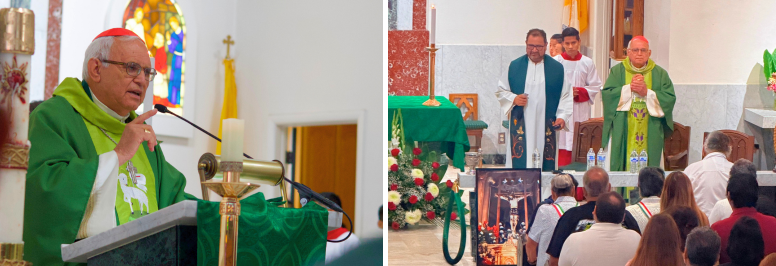
Parishioners at Our Lady of Guadalupe Shrine in Riverside welcomed Guatemalan Cardinal on July 12 for a powerful reflection that connected the global climate crisis with the Christian call to conversion, stewardship, and discipleship. Drawing upon Scripture and the Gospel of the day, Cardinal Ramazzini challenged the faithful to consider humanity's role in the environmental changes affecting communities throughout the world. "Without rain there is no water, and without water there is no vegetation," the Cardinal said, noting that rivers are drying up and temperatures continue to rise. He pointed to humanity's dependence on fossil fuels and unsustainable patterns of consumption as major contributors to climate change. "The earth feels it, people feel it, and the animals feel it," he said, reflecting on the dramatic increase in temperatures being experienced around the globe.
The Cardinal emphasized that the environmental crisis is not simply a scientific or political issue but a spiritual one that calls for a change of heart and a renewed relationship with God's creation. Reflecting on the encounter between Jesus and the Samaritan woman at the well, Cardinal Ramazzini noted that Christ begins with a simple request for water and opens a dialogue that transforms lives. He invited the faithful to enter into that same life-giving dialogue with Christ in their own hearts, allowing it to transform them as it did the Samaritan woman. "Jesus must speak not only to our minds but also to our hearts," he said, encouraging believers to find a balance between intellect and emotion and to pass these values on to future generations.
The Cardinal also reflected on the words of the prophet Isaiah: "Just as the rain and snow come down from heaven and do not return there until they have watered the earth, so shall my word be." He challenged families to examine the place that Sacred Scripture occupies in their daily lives. "What importance do we give to the Word of God?" he asked. "How often do we create space as families to open the New Testament and nourish our spiritual lives?"
Turning to the Gospel parable of the Sower, Cardinal Ramazzini reminded the congregation that the seed of God's Word is offered generously to all people, but its fruitfulness depends on the condition of the soil that receives it. Some hear the Word and quickly forget it. Others receive it with enthusiasm but fail to cultivate it through consistency and prayer. Still others allow worldly concerns, material possessions, and anxieties to choke its growth. The challenge for Christians, he said, is to allow the Word of God to settle deeply within them, to understand it, reflect upon it, and allow it to reach their hearts. Faith, he added, cannot be sustained only by occasional celebrations or sacramental milestones. He has noticed that there rupture between the years of sacraments where we often never see those receiving the gifts of the Spirit. Cardinal Ramazzini reminded the congregation that Baptism, First Communion, and Confirmation are not endpoints but beginnings of a lifelong spiritual journey that must be nourished day after day, particularly within the family.
Finally, Cardinal Ramazzini invited the faithful to consider the "good soil" described by Jesus as a model of authentic discipleship. He explained that the Lord calls each person to embrace and live His teachings fully. While some may respond at 100 percent and others at 60 or 30 percent, he challenged the faithful to ask themselves: "What percentage am I?" His prayer, however, was that no one would respond with zero percent, choosing not to live the Gospel at all.
His message left those gathered with a challenge both personal and communal: to care for creation, to deepen their relationship with God's Word, and to cultivate hearts capable of bearing abundant fruit for the Kingdom of God.
El cardenal guatemalteco Ramazzini visita el Santuario de Nuestra Señora de Guadalupe
Los feligreses del Santuario de Nuestra Señora de Guadalupe, en Riverside, dieron la bienvenida al Cardenal guatemalteco el pasado 12 de julio para escuchar una profunda reflexión que unió la crisis climática mundial con el llamado cristiano a la conversión, el cuidado de la creación y el discipulado.
Basándose en la Sagrada Escritura y en el Evangelio del día, el Cardenal Ramazzini invitó a los fieles a reflexionar sobre el papel de la humanidad en los cambios ambientales que afectan a las comunidades de todo el mundo. “Sin lluvia no hay agua, y sin agua no hay vegetación”, afirmó el Cardenal, señalando que los ríos se están secando y las temperaturas continúan aumentando. Señaló que la dependencia de la humanidad del petróleo, el carbón y el gas natural, así como los patrones de consumo insostenibles, son factores importantes que contribuyen al cambio climático. "La tierra lo siente, las personas lo sienten y los animales lo sienten”, afirmó al reflexionar sobre el drástico aumento de las temperaturas que se registra en todo el mundo.
El Cardenal subrayó que la crisis ambiental no es únicamente un problema científico o político, sino también un desafío espiritual que exige una conversión del corazón y una relación renovada con la creación de Dios. Al meditar sobre el encuentro entre Jesús y la mujer samaritana junto al pozo, recordó que Cristo inicia el diálogo con una sencilla petición de agua, abriendo así un encuentro que transforma vidas. Invitó a los fieles a entablar ese mismo diálogo vivificante con Cristo en lo más profundo de su corazón, permitiendo que Él los transforme, tal como transformó a la mujer samaritana. “Jesús debe hablar no solamente a nuestra mente, sino también a nuestro corazón”, afirmó, animando a los creyentes a encontrar un equilibrio entre la razón y los sentimientos, y a transmitir estos valores a las futuras generaciones.
El Cardenal también reflexionó sobre las palabras del profeta Isaías: “Así como la lluvia y la nieve descienden del cielo y no vuelven allá sin haber empapado la tierra, así será mi palabra”. A partir de este pasaje, invitó a las familias a examinar el lugar que ocupa la Sagrada Escritura en su vida cotidiana. “¿Qué importancia le damos a la Palabra de Dios?”, preguntó. “¿Con qué frecuencia hacemos espacio en nuestras familias para abrir el Nuevo Testamento y alimentar nuestra vida espiritual?”
Al referirse a la parábola del sembrador, el Cardenal Ramazzini recordó a la asamblea que la semilla de la Palabra de Dios se ofrece generosamente a todas las personas, pero que su fruto depende de la calidad de la tierra que la recibe. Algunos escuchan la Palabra y pronto la olvidan. Otros la reciben con entusiasmo, pero no la cultivan con perseverancia ni mediante la oración. Otros más permiten que las preocupaciones del mundo, las riquezas y las inquietudes ahoguen su crecimiento. El desafío para todo cristiano explicó, es permitir que la Palabra de Dios eche raíces profundas en el corazón, comprenderla, meditarla y dejar que transforme la vida.
Añadió que la fe no puede sostenerse únicamente mediante celebraciones ocasionales o momentos importantes de la vida sacramental. Señaló que con frecuencia existe una ruptura entre los años en que se reciben los sacramentos, pues muchas veces quienes han recibido los dones del Espíritu Santo dejan de participar en la vida de la Iglesia. Recordó a la congregación que el Bautismo, la Primera Comunión y la Confirmación no son un punto de llegada, sino el comienzo de un camino espiritual que debe alimentarse cada día, especialmente dentro del hogar y la familia.
Finalmente, el Cardenal Ramazzini invitó a los presentes a contemplar la “tierra buena” descrita por Jesús como modelo del auténtico discípulo. Explicó que el Señor llama a cada persona a acoger plenamente sus enseñanzas y a vivirlas con fidelidad. Aunque algunos puedan responder al ciento por ciento, otros al sesenta o al treinta por ciento, desafió a los fieles a preguntarse: “¿Qué porcentaje soy yo?”. Su oración, sin embargo, fue que nadie respondiera con un cero por ciento, eligiendo no vivir el Evangelio.
Su mensaje dejó a todos los presentes un llamado personal y comunitario: cuidar la creación, profundizar su relación con la Palabra de Dios y cultivar corazones capaces de dar frutos abundantes para el Reino.
Wilfredo Aguirre is the Diocesan Director of Advocacy, Justice for Immigrants & Hispanic Affairs.